Data Encryption Standard (DES) and Triple DES (3DES/TDES) remain embedded in payment ecosystems long after general-purpose IT moved to AES. PIN encryption, legacy key-wrap schemes, MAC algorithms, and interoperability with older HSMs still surface DES-family primitives—often in ECB or CBC modes with careful attention to parity-adjusted keys and correct block alignment.
For testers, the goal is not “math for its own sake”—it is bit-exact reproducibility: the same key, IV, mode, and padding assumptions your host and HSM use. ISO8583Studio (iso8583.studio) is a free cross-platform desktop application for Windows, macOS, and Linux with 64 payment tools, including cryptography modules (AES, DES/3DES, RSA, ECDSA, hash, FPE) alongside Host Simulator, HSM Simulator (PayShield 10K), EMV utilities, and key-management calculators.
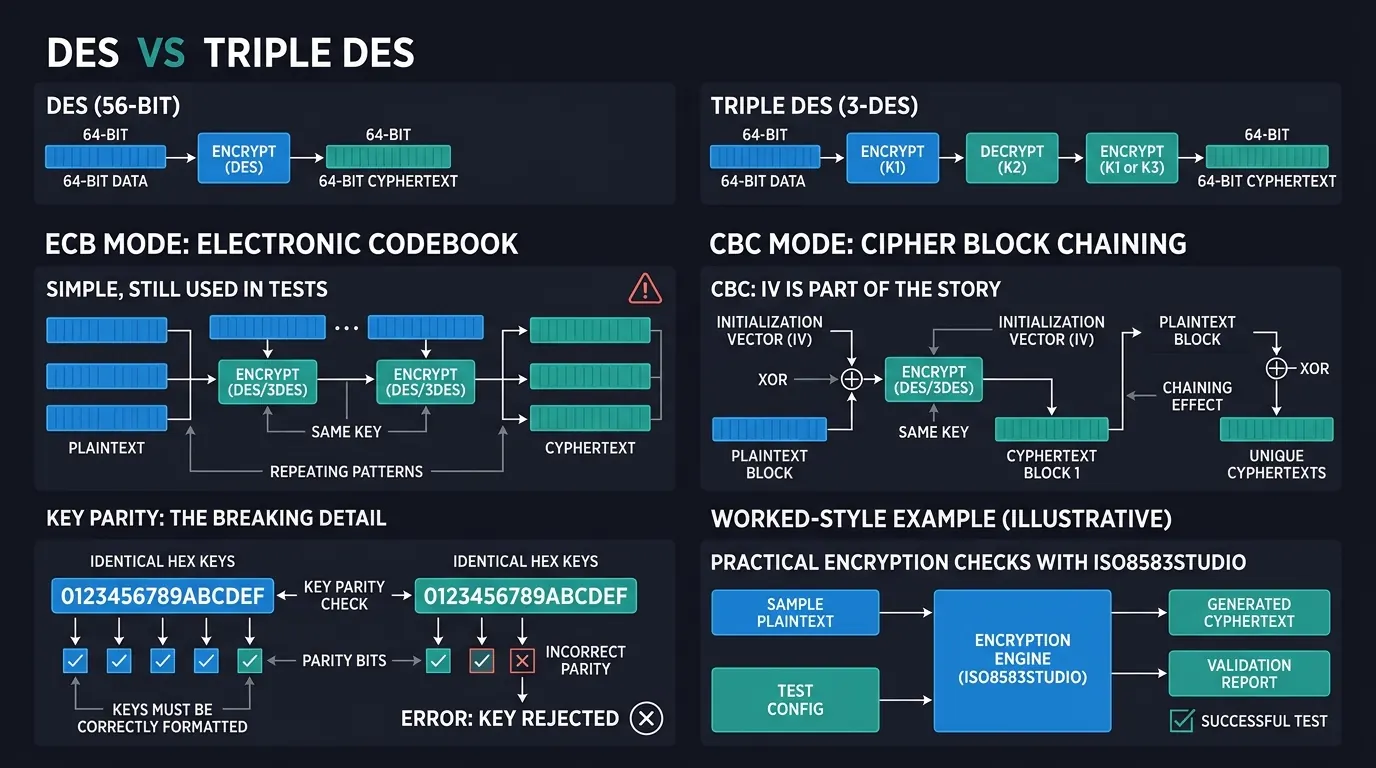
DES vs Triple DES in one paragraph
- DES uses 56-bit effective key material in an 8-byte key (8 parity bits).
- Triple DES typically applies Encrypt-Decrypt-Encrypt (EDE) with two or three key parts, yielding TDES-2 or TDES-3 effective strengths depending on configuration.
When a specification says “3DES,” always confirm which keying option is intended—mixing TDES-2 and TDES-3 assumptions is a classic certification failure.
ECB mode: simple, dangerous, still used in tests
ECB encrypts each 8-byte block independently. It leaks structure if plaintext repeats—so it is a poor choice for bulk data. Yet labs still use ECB for:
- Controlled test vectors with single-block inputs.
- Legacy interfaces that explicitly require ECB.
Testing checklist:
| Check | Why it matters |
|---|---|
| Block alignment | DES operates on 8-byte blocks |
| Key parity | Many APIs require odd parity per byte |
| Output length | Should be multiple of 8 for unpadded ECB |
If your ciphertext length is not a multiple of the block size, you are not comparing apples to apples—padding or truncation is in play.
CBC mode: IV is part of the story
CBC XORs each plaintext block with the previous ciphertext block before DES; the first block uses an IV. That means:
- The same key and plaintext produce different ciphertext with different IVs—by design.
- Test harnesses must log IV + ciphertext together.
Testing checklist:
| Check | Detail |
|---|---|
| IV uniqueness | Reusing IV under the same key weakens CBC |
| IV length | 8 bytes for DES/3DES block size |
| Chaining | One corrupted block propagates—useful for fault tests |
Key parity: the detail that breaks “identical” keys
Payment systems often represent DES keys as 8-byte values with odd parity on each byte. Some tools accept raw hex and adjust parity silently; others require pre-adjusted bytes. When two implementations disagree, you will see completely different ciphertext with “the same” key on paper.
Practical approach:
- Fix a canonical hex key in your test plan.
- Document whether parity adjustment is applied before encryption.
- Compare ciphertext against a reference implementation (tool or HSM trace).
Worked-style example (illustrative)
Assume an 8-byte single-block plaintext P and key K. In ECB:
C = DES_Encrypt(K, P)
In CBC with IV IV:
X = P ⊕ IV
C1 = DES_Encrypt(K, X)
Your regression suite should include:
- ECB vector(s) for sanity.
- CBC vector(s) with pinned IV.
- A negative test where IV is changed intentionally to prove your verifier binds IV correctly.
Common integration mistakes
- Padding ambiguity — PKCS#5/7 padding differs from zero padding; hosts sometimes pad oddly.
- TDES key ordering — EDE key part order must match your KCV and HSM import format.
- Character encoding — Encrypting ASCII vs. EBCDIC-looking numerics changes bytes and outcomes.
Using ISO8583Studio for DES/3DES testing
ISO8583Studio centralizes symmetric crypto next to payment-specific workflows: CVV, PIN block, DUKPT, MAC/HMAC/CMAC, and key calculators (Thales, Futurex, Atalla, SafeNet, TR-31, keyshare, DEA keys). That proximity matters—PIN translation exercises often chain 3DES + PIN block format + key block in one scenario.
When to prefer AES in new designs
For greenfield systems, AES is the modern default. DES/3DES persists where standards, BIN ranges, or HSM firmware require it. Your testing strategy should treat legacy crypto as contract testing: reproduce published vectors and HSM outputs exactly, not “approximately.”
Traceability: how labs pass audits
Keep a vector register: date, library or HSM firmware version, key hex (masked in shared docs), IV, mode, plaintext category (random, all-zero, maximum length), and ciphertext. When a partner disputes a result, you can diff parameters instead of arguing from memory. For cross-border projects, also record endianness and any character-set conversion applied before encryption—those layers are where “same key, different ciphertext” mysteries originate.
Conclusion
DES and Triple DES testing is about disciplined parameters: mode, IV, parity, padding, and TDES keying option. Download ISO8583Studio from https://iso8583.studio—a free desktop toolkit for encryption, payment primitives, EMV utilities, and simulators—so your lab can validate symmetric crypto with the same rigor you apply to message formats and host protocols.