When a chip transaction fails, someone pastes a hex blob into chat and asks, “What does this mean?” Without a disciplined TLV mental model, you guess. With BER-TLV literacy and a good tag parser, you answer with evidence. ISO8583Studio is a free desktop app (Windows, macOS, Linux) built with Kotlin/Compose; its EMV tools include a tag parser, tag dictionary, and related utilities so payment developers can move from opaque hex to structured diagnostics quickly.
This guide explains EMV TLV parsing, the BER-TLV layout, and how to use a parser without fooling yourself.
Why TLV shows up everywhere in EMV
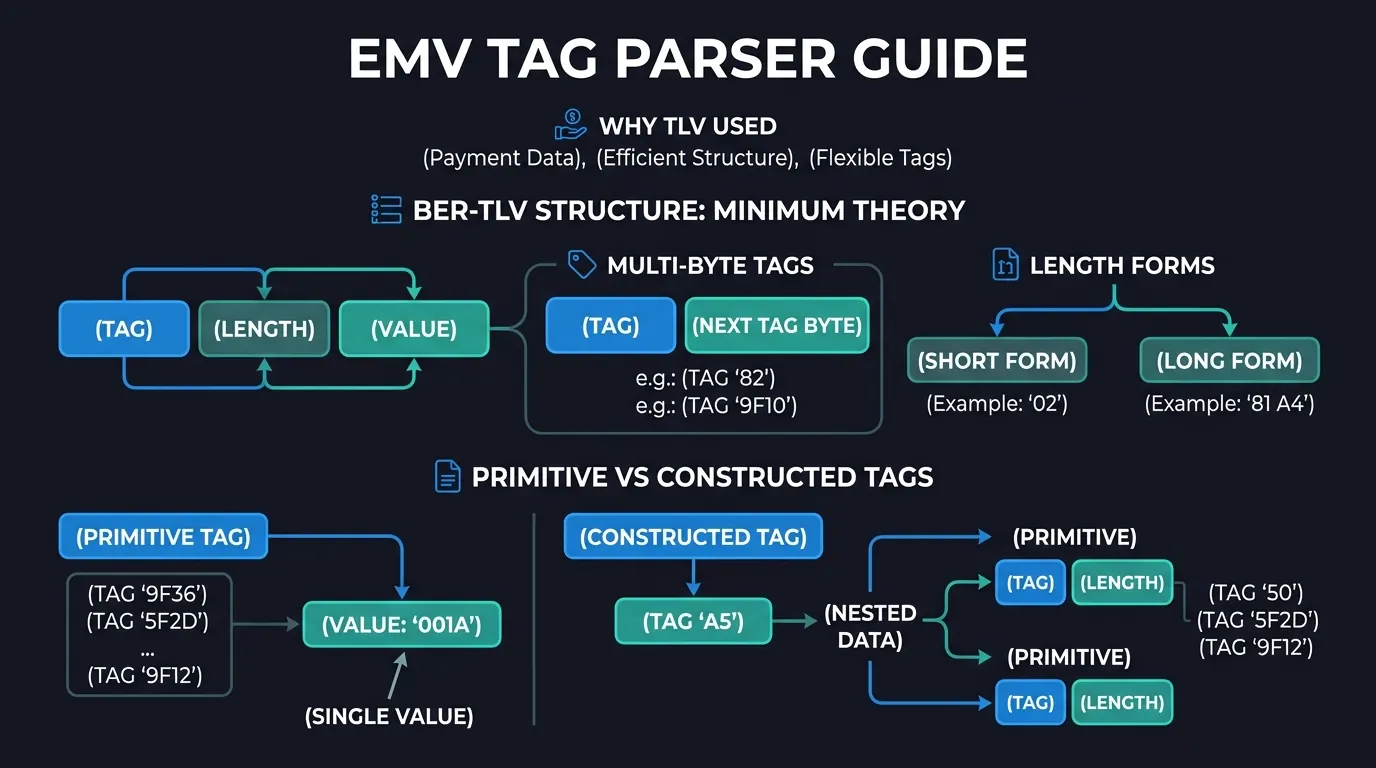
Tag-Length-Value encoding packs typed fields into a single byte stream:
- Tag identifies the data object (e.g., track 2 equivalent data, PDOL-related items).
- Length tells you how many value bytes follow.
- Value is either raw content or—if constructed—nested TLV children.
EMV uses BER-TLV rules (DOLs and kernel requirements add more constraints). The payoff: parsers can walk unknown streams if tags and lengths are well-formed.
BER-TLV structure: the minimum viable theory
Tags can be multi-byte
Do not assume one byte. Tags continue while the continuation rules indicate more bytes—your parser must implement the encoding rules, not a naive tag = firstByte.
Length forms
Lengths may be short or long depending on value size. A parser must support:
- Single-byte lengths for small values
- Multi-byte length encodings for larger payloads
If your “quick script” only handles short lengths, you will eventually hit a real-world blob that breaks it.
Primitive vs constructed tags
| Kind | Meaning |
|---|---|
| Primitive | Value bytes are payload (ASCII digits, binary crypto, etc.) |
| Constructed | Value bytes contain nested TLV |
Misclassifying a constructed object as primitive is a classic way to misinterpret issuer application data and records inside PPSE/AID selections.
DOLs: tags in templates, not only in messages
Data Object Lists (PDOL, CDOL1, CDOL2, DDOL) describe what the terminal must provide and in what order. Parsing a message is only half the job—you must also reconcile terminal input with kernel expectations.
Practical tip
When debugging, print:
- Parsed top-level TLV
- Expanded constructed nodes
- A flattened map of
tag → valuefor search—while remembering duplicates exist and context matters
Using ISO8583Studio’s tag parser tool
A purpose-built parser helps you:
- Validate hex input normalization (spaces,
0xprefixes, case) - Expand nested structures without hand-counting lengths
- Cross-reference tag names via a dictionary when you forget the mnemonic
Workflow:
- Paste EMV data from your capture tool (sanitize first).
- Parse and identify critical path tags for your issue (cryptogram, ATC, unpredictable number).
- Compare against expected kernel behavior for your card product.
Common pitfalls (and how to avoid them)
- Truncated streams: last object incomplete → your parser should fail loudly, not silently drop bytes.
- Duplicate tags: some contexts allow multiples; naive maps lose data—use lists or scoped contexts.
- Sensitive data: never share full captures publicly—mask PAN, truncate track equivalents, and remove PIN-related artifacts.
Worked-style example (illustrative hex)
Consider a toy TLV sequence (values fabricated):
9F36020001 9F3704A1B2C3D4
Your parser should report:
9F36(Application Transaction Counter) length02value00019F37(Unpredictable Number) length04valueA1B2C3D4
Real kernels nest far deeper—this only illustrates walking bytes reliably.
Pairing parsers with other EMV tooling
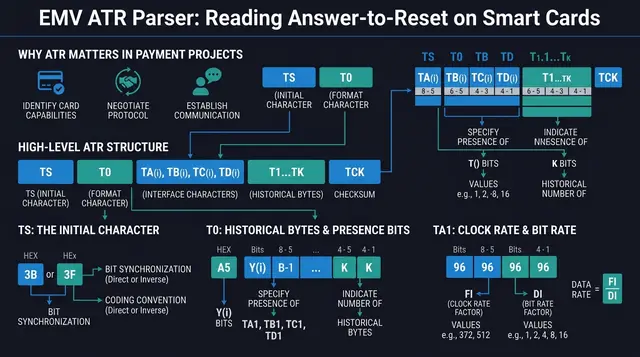
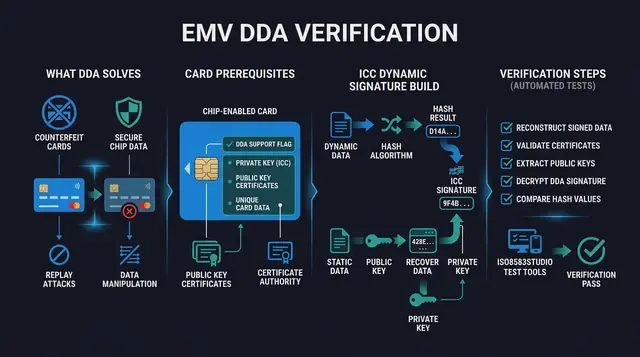
ISO8583Studio also provides EMV data parser, ATR parser, cryptogram validation, and SDA/DDA verification helpers—so TLV parsing becomes the first step in a longer crypto validation chain.
SEO keywords, naturally
Teams search for EMV TLV parser, BER-TLV, tag dictionary, and chip card debugging—this workflow matches those intents: structured extraction, kernel alignment, and reproducible captures.
Building a personal tag notebook
Maintain a notebook (Markdown, Notion, or wiki) with three sections:
- Kernel-specific quirks you observed (duplicate tags, proprietary tags)
- Your most frequent tags with short meanings and typical lengths
- Failure signatures (“if 9F10 looks wrong, check issuer discretionary data first”)
This sounds old-fashioned until you onboard someone during a live incident—your notebook becomes the fastest map from panic to progress.
Performance and parser safety
For large captures, prefer streaming parsers or strict length bounds to avoid accidental quadratic behavior when deeply nested TLV appears. EMV blobs are small compared to logs, but embedded systems teams still appreciate O(n) guarantees when parsing on-device.
When parsing fails, preserve the first offending offset in error messages—future readers can jump straight to the byte that broke assumptions.
If you teach EMV parsing to newcomers, have them manually parse one TLV by hand once—painful, unforgettable, and it prevents over-trusting tools.
Conclusion
EMV TLV parsing is a foundational skill for anyone touching contact or contactless payments. ISO8583Studio’s EMV tag parser and companion tools turn hex anxiety into repeatable engineering.
Download ISO8583Studio for free at https://iso8583.studio and parse chip data like a reviewer—fast, structured, and audit-friendly.