When a card transaction fails, someone always asks: “What did the issuer say?” In many ISO 8583 implementations, the first-pass answer is Field 39, the response code. It looks simple—two characters—but it sits at the intersection of issuer policy, fraud rules, stand-in processing, merchant category restrictions, and plain old message formatting mistakes.
This article provides a practical Field 39 mindset: how to interpret common patterns, how to triage declines without jumping to conclusions, and how to separate host decisions from integration errors. For hands-on inspection of ISO 8583 artifacts, consider ISO8583Studio, a free cross-platform desktop application for payment developers (https://iso8583.studio).
What Field 39 represents
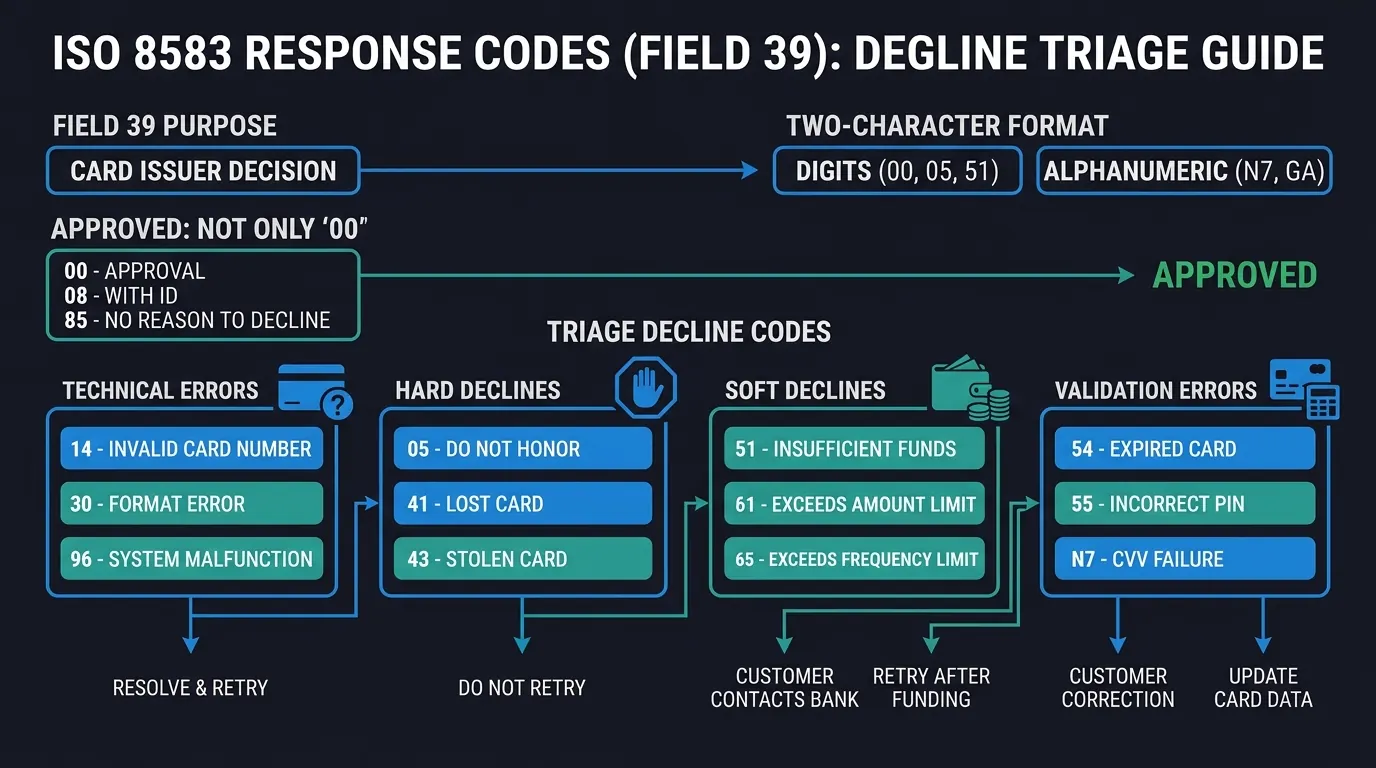
Field 39 communicates the authorization outcome (or a processing outcome for non-financial messages, depending on context). Networks add their own values alongside the base set (91 and 96, for instance, are base codes, not private ones), but the base set below has the same meaning in every country and network—your implementation guide defines valid values, synonyms, and special stand-in behaviors.
The two-character format: not always “obvious”
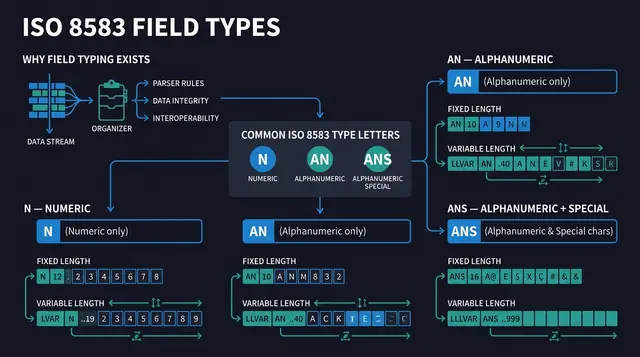
Field 39 is often displayed as:
- Two numeric digits (
00,05,51, …) - Sometimes alphanumeric codes in certain environments (rarer, but possible depending on variant)
Always confirm whether your network uses:
- Approved vs declined vs partial approval conventions
- Retry vs do-not-retry guidance for specific codes
“Approved” is not always only 00
Many teams anchor on 00 as approval, but some flows use additional approved/partial-approved semantics depending on the processor. If you build merchant UX solely around 00, you may mishandle legitimate partial approvals where permitted.
Common decline families
Learn these categories first; the code table further down gives the standard values.
Insufficient funds / credit line
Often discussed with codes that imply not sufficient funds or credit limits. Merchant messaging typically needs careful wording to avoid asserting “issuer said X” when the code is ambiguous across card brands.
Expired card / invalid card
These declines may correlate with date issues, bad PAN entry, or token problems—not only “expired plastic.”
Restricted card / activity not allowed
Sometimes the issuer blocks a merchant category, geography, or transaction type.
Suspected fraud / security
Fraud-related outcomes can be volatile; retries may worsen risk scoring.
Format / system errors (the integration trap)
Some environments expose codes that effectively mean “this did not reach issuer decisioning” or “system error.” Do not treat every non-00 as a moral judgment from the issuer—first confirm the message was well-formed and MAC-valid.
Troubleshooting workflow: Field 39 is step three, not step one
A disciplined triage order:
- Transport success: did the message reach the correct endpoint?
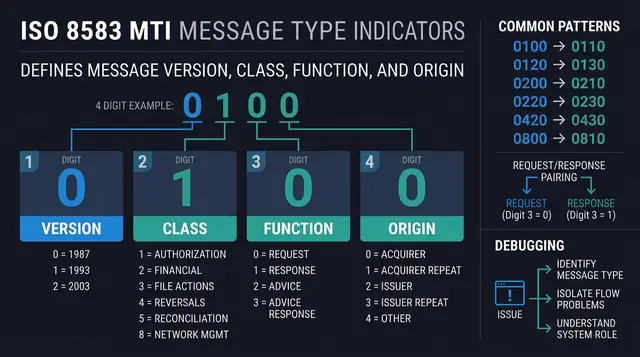
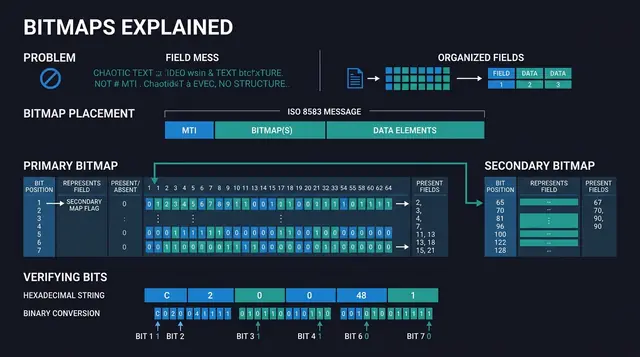
- Parsing validity: MTI, bitmap, field boundaries, required fields present?
- Cryptographic validity: MAC/HMAC/CMAC correct where required?
- Business outcome: now interpret Field 39 in context.
Skipping straight to Field 39 is how teams “fix” issuer policies that were never the problem.
Correlation fields: response matching done right
When debugging declines, capture correlation identifiers your network uses (examples often include STAN/time components, retrieval references, and network-specific tokens—per your guide). If your response cannot be matched to a request, your Field 39 interpretation may be analyzing the wrong transaction entirely.
The ISO 8583:1987 base response codes
| Code | Meaning (ISO 8583:1987 base set) | Retry? |
|---|---|---|
00 |
Approved | — |
01 |
Refer to card issuer | No |
03 |
Invalid merchant | No |
04 |
Pick up card | No |
05 |
Do not honour (generic issuer decline) | No |
12 |
Invalid transaction | No |
13 |
Invalid amount | No |
14 |
Invalid card number | No |
30 |
Format error — the message is malformed; fix your integration | No |
41 |
Lost card, pick up | No |
43 |
Stolen card, pick up | No |
51 |
Insufficient funds | Later |
54 |
Expired card | No |
55 |
Incorrect PIN | Re-prompt |
57 |
Transaction not permitted to cardholder | No |
61 |
Exceeds withdrawal amount limit | Later |
65 |
Exceeds withdrawal frequency limit | Later |
91 |
Issuer or switch inoperative | Retry |
96 |
System malfunction | Retry |
00 is the only unconditional approval in the base set. 30 and 96 point at your integration or the network, not the cardholder — treat them as defects, not declines.
Note: these are the ISO 8583:1987 base values. Your network's implementation guide is authoritative for the codes it adds or redefines.
When Field 39 lies (indirectly)
Field 39 can mislead if:
- You parsed the wrong message due to boundary errors
- You are looking at a gateway-mapped code that differs from the raw issuer code
- Stand-in authorization substituted a simplified outcome
Always ask: Are we seeing issuer-native codes or processor-normalized codes?
How ISO8583Studio supports decline investigations
ISO8583Studio helps you validate the mechanical correctness of a message before you debate issuer policy: ISO 8583 structure inspection, EMV TLV parsing for chip contexts, and cryptographic utilities for MAC verification—alongside simulators for rehearsing flows.
Download the latest release for Windows, macOS, or Linux:
Conclusion
Field 39 is the headline, but it is rarely the whole story. Use it as the outcome signal after you establish that the message was framed correctly, authenticated correctly, and correlated to the right request. Build a network-specific mapping, teach support teams which codes are retry-safe, and keep debugging disciplined. ISO8583Studio gives payment developers a local workbench to inspect ISO 8583 traces and related crypto/EMV artifacts—so your next “declined” ticket is solved with evidence, not guesses.